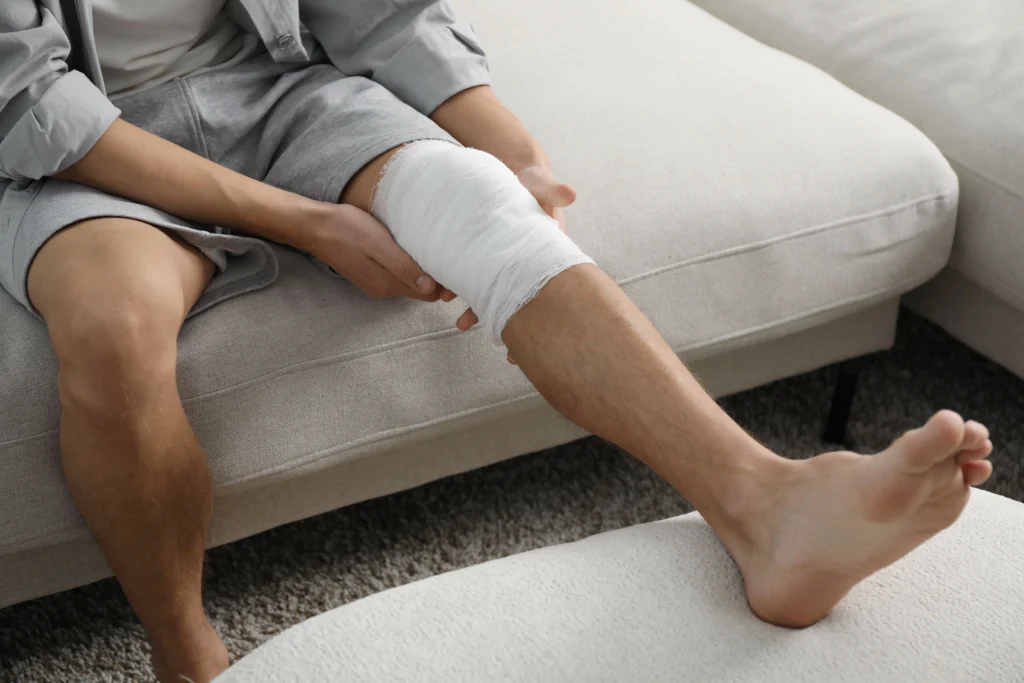
There is no cast, no crutches, and no dramatic X-ray to point to. From the outside, you look completely fine. But you are the one who cannot turn your head to check a blind spot, who winces getting out of bed, who has not slept through the night since the crash. When you mention it, you can almost feel people deciding you are exaggerating, and the insurance adjuster makes that doubt official by treating your pain like it is barely real. So you start to wonder whether a soft tissue injury is even worth pursuing, or whether the law in Florida will brush it aside the same way everyone else seems to.
The honest answer is that yes, you can sue for a soft tissue injury in Florida, but the law puts a specific gate in front of you, and clearing it comes down to proof. These claims are among the most disputed in the state, not because the injuries are not real, but because they are invisible and easy to challenge. This article walks through what soft tissue injuries are, when Florida law lets you take the at-fault driver to court, and how to build a claim the insurance company cannot wave away.
What Counts as a Soft Tissue Injury?
A soft tissue injury is damage to the muscles, tendons, and ligaments rather than to bone. They are extremely common in car accidents because the sudden force of a collision wrenches the body in ways it was never built to handle. Common examples include the following.
- Whiplash, the rapid back-and-forth motion that strains the neck
- Sprains and strains in the back, shoulders, and joints
- Contusions, the deep bruising of muscle tissue
- Tendon and ligament tears that limit movement and strength
The frustrating part is that these injuries rarely show up on a standard X-ray, which looks at bone. They can be very painful, they can take months to heal, and in some cases they never fully resolve, leaving lasting stiffness, weakness, or chronic pain. None of that makes them less real. It just makes them harder to prove, which is exactly the gap insurance companies try to exploit.
Can You Actually Sue, or Are You Stuck With PIP?
This is where Florida’s no-fault system changes the math. After a crash, you turn first to your own Personal Injury Protection coverage. Under Florida Statute 627.736, PIP provides up to $10,000 that pays 80 percent of your medical bills and 60 percent of lost wages, regardless of who caused the accident. For a soft tissue injury that heals quickly, PIP may be the only recovery available, and that is by design.
To step outside PIP and sue the at-fault driver for the full weight of your losses, including pain and suffering, your injury has to clear the serious injury threshold. Under Florida Statute 627.737, that means one of these.
- Significant and permanent loss of an important bodily function
- Permanent injury within a reasonable degree of medical probability
- Significant and permanent scarring or disfigurement
- Death
For soft tissue cases, the permanent injury category is almost always the one that matters. A neck strain that fully resolves in three weeks will not get you there. But a soft tissue injury that leaves you with lasting limited range of motion, chronic pain, or a documented permanent impairment can. The dividing line is permanence, and proving it is the heart of the case.
How Do You Prove a Soft Tissue Injury Is Permanent?
Permanence is not something you can declare for yourself. Under the threshold, a treating physician has to state, within a reasonable degree of medical probability, that your injury is permanent. That usually cannot happen overnight. Doctors generally wait until you reach what they call maximum medical improvement, the point where your condition has stabilized and they can judge what is going to heal and what is not. For soft tissue injuries, reaching that point often takes several months.
A few kinds of evidence carry the most weight in these cases.
- Consistent medical records. A steady treatment history that connects your symptoms directly to the crash is the backbone of the claim.
- Imaging that goes beyond an X-ray. An MRI can reveal disc and soft tissue damage that an X-ray misses entirely.
- A physician’s permanency opinion. A treating doctor willing to document permanence is often what unlocks a non-economic damages claim.
- A record of how your life changed. Notes on the activities, work tasks, and routines you can no longer manage make the injury concrete.
This is also where the fight usually happens. Insurance companies routinely send your records to a doctor of their choosing, and that doctor very often concludes your injury is not permanent. The case can come down to which physician a jury believes, yours or theirs, which is why the quality and consistency of your medical documentation matter so much. Our look at the common mistakes that can sink a Florida injury claim covers several of the habits that quietly hand the insurer that argument.
What If Your Injury Is Not Permanent? You May Still Have Options
Here is a point that gets lost constantly, and it matters. The permanent injury threshold only blocks non-economic damages, meaning pain and suffering. It does not block everything. Even if your soft tissue injury does not qualify as permanent, you can still pursue the at-fault driver for your economic losses that go beyond PIP, such as the remaining portion of your medical bills, your full lost wages, and your property damage. This rule was confirmed long ago by the Florida Supreme Court in Auto-Owners Insurance Co. v. Tompkins, 651 So.2d 89 (Fla. 1995). So even a claim that does not reach the threshold is not automatically worthless, and you should never assume otherwise based on an adjuster’s say-so. The way these claims build from the no-fault layer into a full case is something we handle routinely in Florida car accident claims.
How Fault Affects a Soft Tissue Claim
Once you move past PIP and pursue the other driver, Florida’s comparative negligence rule comes into play, and it raises the stakes. Since House Bill 837 took effect in March 2023, Florida follows a modified comparative negligence standard under Florida Statute 768.81. If you are 50 percent or less at fault, your recovery is reduced by your share of the blame. If you are found more than 50 percent at fault, you recover nothing.
Picture a claim worth $40,000 where you are assigned 15 percent of the fault. You recover $34,000. Push your share above 50 percent, and the claim disappears entirely. With soft tissue cases, where insurers already question the injury itself, they will often try to stack a fault argument on top, suggesting you stopped short or contributed somehow. Pushing back on both fronts with evidence is what protects the value of the claim.
Why Soft Tissue Claims Get Lowballed, and How to Respond
Insurers treat soft tissue injuries as their easiest target. The injury does not show on an X-ray, the symptoms are subjective, and they are betting you will accept a quick, small offer just to be done. A few moves protect you from that.
- See a doctor promptly and never let your treatment lapse, because gaps in care are the first thing an adjuster points to.
- Report every symptom, even the ones that feel minor, so the record is complete.
- Decline to give a recorded statement before you have advice.
- Do not accept the first offer, which is almost always built on the assumption your injury is trivial.
Key Takeaways
- You can sue for a soft tissue injury in Florida, but only if it meets the serious injury threshold under Florida Statute 627.737, most often through the permanent injury category.
- After a crash, your own PIP under Florida Statute 627.736 pays first, covering 80 percent of medical bills and 60 percent of lost wages up to $10,000.
- Proving permanence usually requires reaching maximum medical improvement and a treating physician’s opinion, supported by consistent records and imaging such as an MRI.
- Even if your injury is not permanent, you can still pursue economic damages beyond PIP, a point confirmed in Auto-Owners Insurance Co. v. Tompkins, 651 So.2d 89 (Fla. 1995).
- Under modified comparative negligence in Florida Statute 768.81, being more than 50 percent at fault bars recovery entirely.
- You generally have two years from the crash to file under Florida Statute 95.11(5)(a).
Frequently Asked Questions
Q: Is whiplash enough to sue the other driver in Florida?
A: It can be, but only if your whiplash rises to a permanent injury under the serious injury threshold. A neck strain that heals in a few weeks generally will not qualify, and your recovery may be limited to PIP. A whiplash injury that leaves lasting limited motion or chronic pain, documented by a treating physician, often does qualify and can open the door to pain and suffering damages.
Q: My X-ray was normal. Does that mean I do not have a real injury?
A: Not at all. X-rays look at bone, and soft tissue injuries involve muscles, tendons, and ligaments, which an X-ray does not show. A normal X-ray is exactly what you would expect with whiplash or a sprain. Imaging like an MRI, along with a clear treatment record, is what captures these injuries.
Q: How long do I have to reach maximum medical improvement before I know if my injury is permanent?
A: There is no fixed timeline, but soft tissue injuries often take several months to stabilize. Your doctor will generally wait until your condition has plateaued before offering an opinion on permanence. This is one reason it is usually wise not to settle too early, before the long-term picture of your injury is clear.
Q: The insurance company offered me a quick settlement. Should I take it?
A: Be cautious. Early offers on soft tissue claims are almost always low and are made before anyone knows whether your injury is permanent. Once you sign a release, the claim is closed for good, even if your condition worsens. Having the offer reviewed first costs you nothing and often reveals what it leaves out.
Q: What if my injury turns out not to be permanent?
A: You may still have a claim. The permanent injury threshold only limits pain and suffering damages, not economic losses. You can still pursue the at-fault driver for medical bills beyond PIP, lost wages, and property damage. Do not assume your case has no value simply because an adjuster says your injury is minor.
Q: Do I really need a lawyer for a soft tissue injury?
A: For a minor injury that heals quickly and is fully covered by PIP, you may be able to handle it yourself. But the moment permanence, lasting pain, or a disputed injury enters the picture, the insurer will fight, and these are exactly the cases where strong medical proof and steady pressure change the outcome. A lawyer can build the permanency case and push back on the lowball tactics these claims attract.
Don’t Let Anyone Tell You Your Pain Doesn’t Count
A soft tissue injury can change how you move, sleep, work, and feel, even though it never shows up on an X-ray. The insurance company is counting on that invisibility to make your claim small. You do not have to accept their version of how much your injury is worth, and you do not have to prove it on your own.
At The Injury Claim Law Firm, our Florida car accident attorneys know how to prove the injuries other people cannot see. We build the medical record, line up the permanency evidence, hold the at-fault driver accountable, and push back hard when insurers try to dismiss real pain as nothing. With over 100 years of combined experience and millions recovered for injured Floridians, we treat these claims with the seriousness they deserve. Your consultation is free, and you pay nothing unless we win.
Reach out today, while your treatment is still active and your injury can be fully documented.